Five years ago, my father died. Passed on to a better life, as they say. Who knows whether that is really true. I would like to believe it, more than anything else. Since then, every year, from May 29 to June 5—the length of time his farewell lasted—I relive the same ordeal. I call it Holy Week. A journey suspended between pain and memory. A pilgrimage of the soul through absence, silence, and questions that still have no answer.
Yes, because I saw my father move forward like Christ, carrying the cross on his shoulders, walking his Calvary and drawing closer to the place of execution. And that Calvary—as he himself called it—we shared. In a way, I lived it too, every moment, every silence, every look that cried out more loudly than a thousand words. I still bear its marks.
That is why, every year, anguish takes hold of me, tightening around my throat until I can barely breathe.
I get out of bed already exhausted and go through my daily life carrying a burden that grows heavier, more insidious, more relentless with each passing day. At first, I thought that perhaps the years would make it lighter, that distance would soften the sharp edges of grief. I was wrong. The weight grows, takes root, wraps itself around me. Or perhaps I am the one growing weaker, no longer able to bear it.
I look around and find no one. No one comes to my rescue. Not a single hand reaches out to me. Only a voice, the echo of someone who once said he loved me, leaning over the edge of the abyss—deeper and deeper—into which I have fallen, shouting, “I’m here for you!”
“Well, thanks. Your ‘being here’? You know where you can put it?”
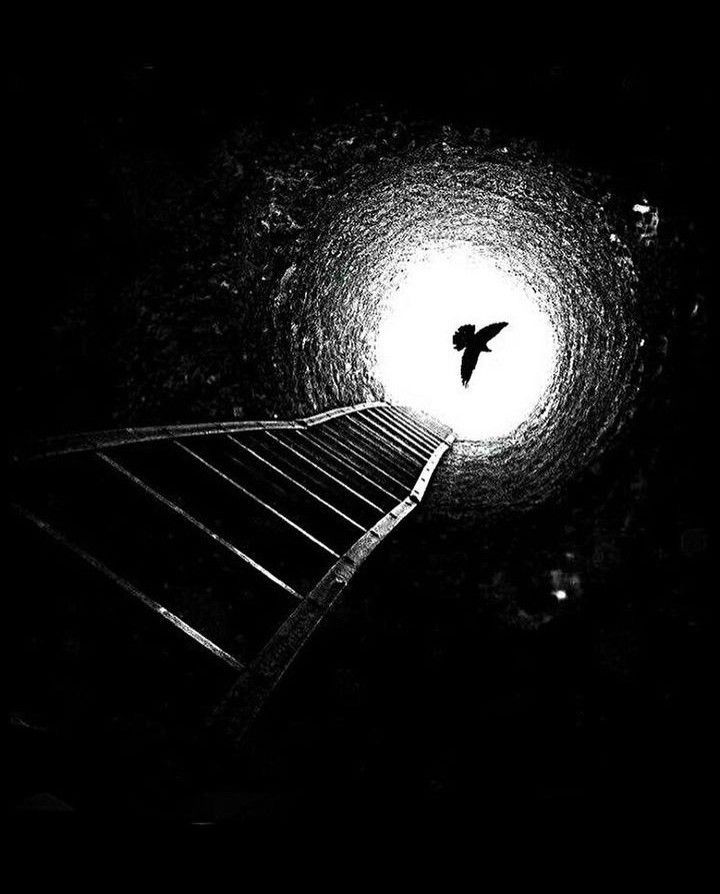
If he really loved me, he would throw down a ladder—a hand would never reach far enough. Better still, he would climb down himself and bring me back to the surface. On my own, I cannot even move.
But no. He stays up there and insists, “The sea up here is wonderful, the sun is shining. You don’t know what you’re missing!”
I feel like answering, “Then drown in it!”
But I don’t, because another sea is filling the hole, and I am drowning in that one. I am suffocating. It is a black sea, impenetrable, thick as jelly. And it is not salty, but bitter.
The abyss—I call it the hole—has changed me. It has made me cruel, I admit it. And selfish too. In truth, I forced myself to become selfish, out of self-defence. Otherwise I would have sunk all the way to the heart of the earth, swallowed by its silence, lost beyond return.
Pain does not dissolve, does not fade. On the contrary, it solidifies. By now it has crystallised. And the more time passes, the more fragments settle around its core and the mass grows larger. Just like a tumour, a metastasis of the soul. And there is no cure. It cannot be removed or denied. It must be accepted, the way one accepts a permanent shadow, an invisible yet inescapable appendage of one’s own being.
I carry on and wait. I have learned to do that, patiently. June 6 arrives, inevitably, just as Easter Monday comes. And the Resurrection, in the end, is mine, not my father’s.
I continue to suffer, of course. Pain does not disappear with a date, nor does it dissolve in the days that follow. It accompanies me, passes through me. But at least I try. To return to life, I mean. To let it brush against me, call me back. I begin to breathe again. And, surprisingly, it is almost pleasant, like the moment when you surface after a long dive, after being forced to hold your breath. The air burns in my lungs, but it is life returning, reclaiming its space, taking possession of its cells again and pushing hard, like the sea driving its waves.
Twenty-one days later, it is my birthday, but since then it has never been the same. It no longer has the same meaning, no longer carries the same light. We used to celebrate it together—me, him, and Angela. A tradition that crumbled with his absence. Yet, thinking about it, my relationship with birthdays has never really been a peaceful one. It happens to many people, I know. And yes, I am one of those who experience birthdays with anxiety, with a melancholy that slips quietly inside. Why celebrate? What should I raise a glass to? To another year ending, to a road growing shorter, step by step?
I look at myself in the mirror and see the corners of my mouth slowly surrendering to the relentless force of gravity. To smile, I would have to fight against it, but that would require a stronger force, an explosion of joy powerful enough to overturn the weight of everything else.
Only no such euphoria ever comes. Almost never. And so the downward curve becomes more pronounced, day after day, unhindered.
And then, what exactly am I supposed to celebrate? This body? Once it was slender, harmonious, capable of drawing looks. Now, clumsy and weighed down, it has made me—if not repellent—then invisible. Transparent, as though I did not really exist.Immediately after my father died, I felt an urgent need to write a story to make him eternal, to rescue him from time. I still wonder why I did it.
I know I was terrified of forgetting. What a fool! How could I ever have forgotten?
And yet that very fear reveals how inclined I am towards self-destruction. If I had truly cared for myself, I would have tried to let go, to consign the fiercest memories to oblivion. Instead, I chose to fix them on paper, to give them shape, to engrave them like scars that can never heal.But—and here the absurd contradiction of human nature reveals itself—since completing the final revision, I have never had the courage to read it again. Sometimes the temptation takes hold of me, but fortunately—perhaps I do love myself a little—I manage to push it away.
Not only have I not forgotten, but the most painful memories are carved into me, sharp and merciless. And they give me no peace. They surface whenever they wish, without warning, without pity. They simply do.
And I, fragile as a spider’s web, endure them. If I still have a shred of strength, I force myself to redirect my thoughts, to take refuge elsewhere—in the pages of a novel, for instance. And for a moment, I am free of them. Or at least I try to be.
Angela and Cristina suffer too. Each of us carries grief differently, wears it against her own skin, lets it flow through her with a unique intensity.
I wish I had Cristina’s strength—perhaps older sisters are all like that—able to bear the weight without breaking. She goes to the cemetery every weekend, without fail. I do not think she has missed a single one. It is her way of showing love, of honouring a father who, despite his initial severity, was always fair and steadfast in his principles.
I cannot do that. I go rarely, and always after a long battle with myself. I know I should. I would like to. But something holds me back: an invisible force, a boulder pressing against my chest and paralysing me.
Perhaps it is the certainty that, the moment I cross that threshold, I will cry. Desperately. And that crying will overwhelm me, annihilate me, remind me of everything I have tried to tame but which still lives inside me, raw and unchanged.
I will place my right hand over his photograph until it is completely covered, and I will stay like that for a long time, sobbing, repeating over and over, “My dad… my dad…,” until the tears have emptied me completely, worn me out, stripped away every last resistance. My legs will give way, and then I will have to sit down and breathe.
The first time I was not alone; I had someone to hold on to. Not anymore. I do not even ask anyone to come with me now. Sometimes the thought crosses my mind of asking one of my children. Then I give up the idea. Why impose on them a pain they do not yet know? Why drag them into a scene that offers no respite? I would end up hiding every tear, disguising the pain. And then what would be the point of going there only to leave a bunch of flowers and run away? The visit would no longer be intimate, nor, if you like, religious.
And besides, I would only instil in them the fear of death—assuming they do not already have it—the same fear my father passed on to me when he realised the end was near. He was trembling. His teeth were chattering incessantly. No, I do not want to pass that fear on to them.
Their time will come, unfortunately, and there is nothing I can do to change the course of things.But perhaps, when it does, they will not suffer for me as much as I am suffering for him.
And so I go alone.Before reaching him, I pass rows of faces carved in stone, names engraved in marble, dates silently telling of time that has passed, now ended. I glance at them, read a name here and there, but never linger.
I am not the one looking at them.
They are looking at me.
Someone seems to call to me. For an instant, I look back, and then I cannot breathe.
They know. They know that sooner or later I too will be there—or somewhere else, in a place those who remain cannot know—and I will watch the temporarily living pass by, those who still believe they have time.
In the end, we are nothing more than dead people capable of walking, breathing, speaking, and loving, clinging to the illusion that all of this can last forever.
They are the ones who truly know.
They know whether eternity really exists.
And perhaps they watch us with a shadow of compassion, aware of the pointless burden of suffering we drag around with us, like ballast we never allow ourselves to release.
And so I keep walking, because turning back would change nothing. Every step brings me closer to the inevitable pain waiting silently, ready to consume me. But facing it is the only way to truly exist.
During this week—at least, this is what I believe—the three of us are like animals that, in the deepest pain, instinctively retreat into hiding. They withdraw from everything and everyone, and they wait. They wait for nature to take its course, for time to do what it must. And so, without even realising it, they set self-healing in motion, a primordial, mysterious force, perhaps even a divine one.
Then, once the week has passed, each of us—who knows from where—finds the strength to emerge from her hiding place.
I climb out of the hole.
It is a crack in the earth, deep and dark, swallowing me without mercy. A kind of artesian well, cursed, like the one that swallowed little Alfredino so many years ago. Even today, that tragedy stays with me. It was one of the first traumas of my life. After birth itself, naturally.
I wonder whether the pain I feel, deep and relentless, is only for the loss of my father or whether it conceals something greater, something more deeply rooted.
Why, instead of fading with time, does it dig ever deeper?
Why, in these five years, has there not been a single day—I would have settled for just one—when my thoughts did not turn to him, to Dad?
They are not always painful memories, not always memories of those final years of battling illness. Sometimes they are light: an anecdote, one of his phrases—the kind that made him unique—a word, a sensation, a scent.
He is there.
Always.
But then, inevitably, that sweetness changes, slipping into nostalgia. And the boundary between nostalgia and pain is thin, barely a breath, a fraction of a second.
I have tried hard to find answers, but nothing. I could not.
What I do know for certain, however, is that when we lose someone we have loved, we do not cry only for them.
We cry for ourselves too.
For what that loss has broken, for what will never return.
Selfishness is carved into human nature, and so here it is, the truth that burns: I cry, too, out of selfishness.
For the selfishness of no longer having a father I can rely on, of no longer being able to feel that solid reassurance, that strength which, even without words, was enough to make me feel safe; of knowing that now my back is exposed and that the ground beneath my feet is no longer firm, but uncertain, crumbling.
I am aware that, from now on, I am the parent who can die.
Who will die, no ifs or buts.
It is only a matter of time.I wonder: will someone be beside me, or will I face the final trial, the hardest one, alone, as I almost always have?
Will my children be there to watch over me, to hold my hand, as we did with our father?
Then I see myself in his place.
Will I cry as he did?
Will one of them stroke my forehead, my cheeks, and whisper that everything will be all right, that I will get through this too, as I always have?
Because that is what I told him, lying.
Knowing I was lying.
And will they ask for forgiveness, and forgive me, without speaking, without moving their lips, so as not to reveal the approaching farewell?
Then, when time has carved distance between before and after, will they still feel that emptiness?
Even after years, will they feel a pain as strong as mine?
Will they think of me every single day of their lives?
Is this, then, the heart of suffering?
Is it the selfish fear of disappearing, of being swallowed by time without leaving a trace?
Is it the awareness that my father will exist for as long as I exist, and then he too will disappear, dissolved into the mist of our ancestors, where, in the end, we are all destined to go?
After all, I myself know nothing about the parents of my great-grandparents. Beyond them, looking backwards, there is only emptiness.
And emptiness is relentless.
Despite everything, even at the bottom of the hole, I find a mysterious strength again, faint but stubborn, like the flame of a candle resisting the wind.It urges me to write.
Because writing, for me, is therapeutic.
And word after word, the knot begins to loosen.
As I unravel it, the pain eases.
The wounds that once throbbed and bled begin to close.
Slowly, I rise, and the light comes nearer.It is pleasantly warm and enveloping.
It holds me in an embrace so intense that I shiver.
And only then do I realise that it is dawn on June 6.
A new year awaits me, made of stumbles and setbacks, but also of small joys—perhaps!—and well-earned achievements—I hope!
With my bones still broken, I prepare myself to do what all of us must do, for as long as we are allowed.
Live.